Pusula — Karabük University Career and Alumni Platform
A career and alumni tracking system that brings students, graduates, employers and academic units onto one platform. Built on Django 5.2 and PostgreSQL, with data protection requirements at the centre of the design.
The problem it solves
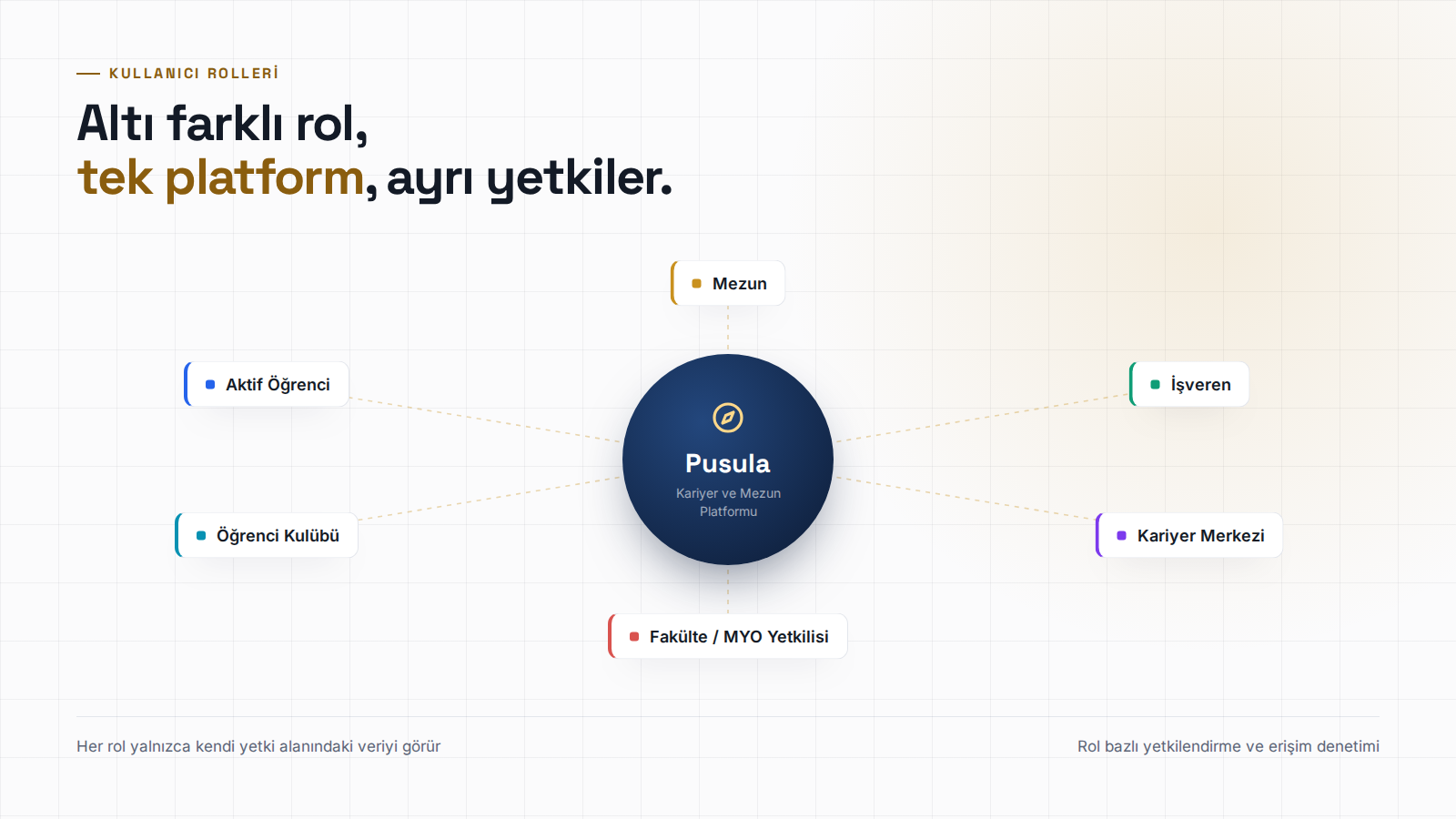
Alumni information at universities is almost always scattered: some of it sits in spreadsheets kept by individual departments, some in social media groups, and a significant share is recorded nowhere at all. During accreditation, or when an employer says "I am looking to hire one of your graduates", that fragmentation turns directly into a problem of reaching the institution. That is why I designed Pusula not as a simple list of graduates but as a platform that makes the relationship with them sustainable. The platform is run within the Karabük University Career Application and Research Centre (UNİKARMER). The system is built on six distinct user roles: current student, graduate, employer, career centre staff, student club and faculty or vocational school officer. Each role sees only the data within its own remit, and that authorisation is not a check bolted on afterwards but part of the data model itself.
Data protection approach
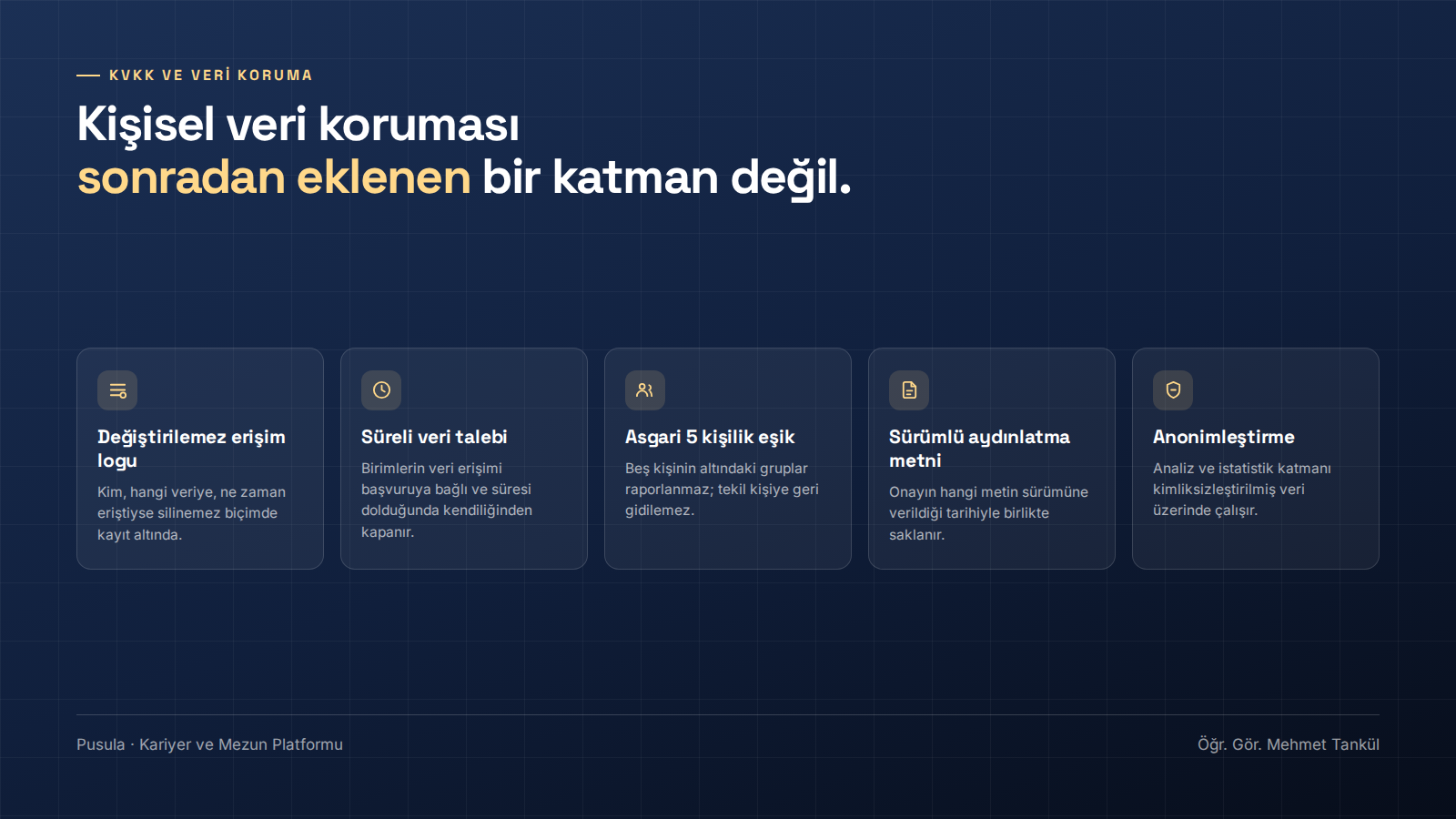
The part of the project I put the most work into was the protection of personal data. Alumni records are, by their nature, a dataset that identifies people directly, so data protection requirements were designed as the system's basic behaviour rather than as a layer added later. Who accessed which data, and when, is held in an access log that cannot be deleted or altered. A department's access to alumni data depends on an application and is time-limited; when the period expires, access closes by itself. Reports do not display groups of fewer than five people, which prevents anyone from tracing a statistic back to an individual. The privacy notice is versioned, and the system records which version of the text a person consented to and on what date; the analytics layer works on de-identified data. The same principle holds on the alumni map: a person is counted in the totals but decides for themselves whether their name is listed.
What it offers
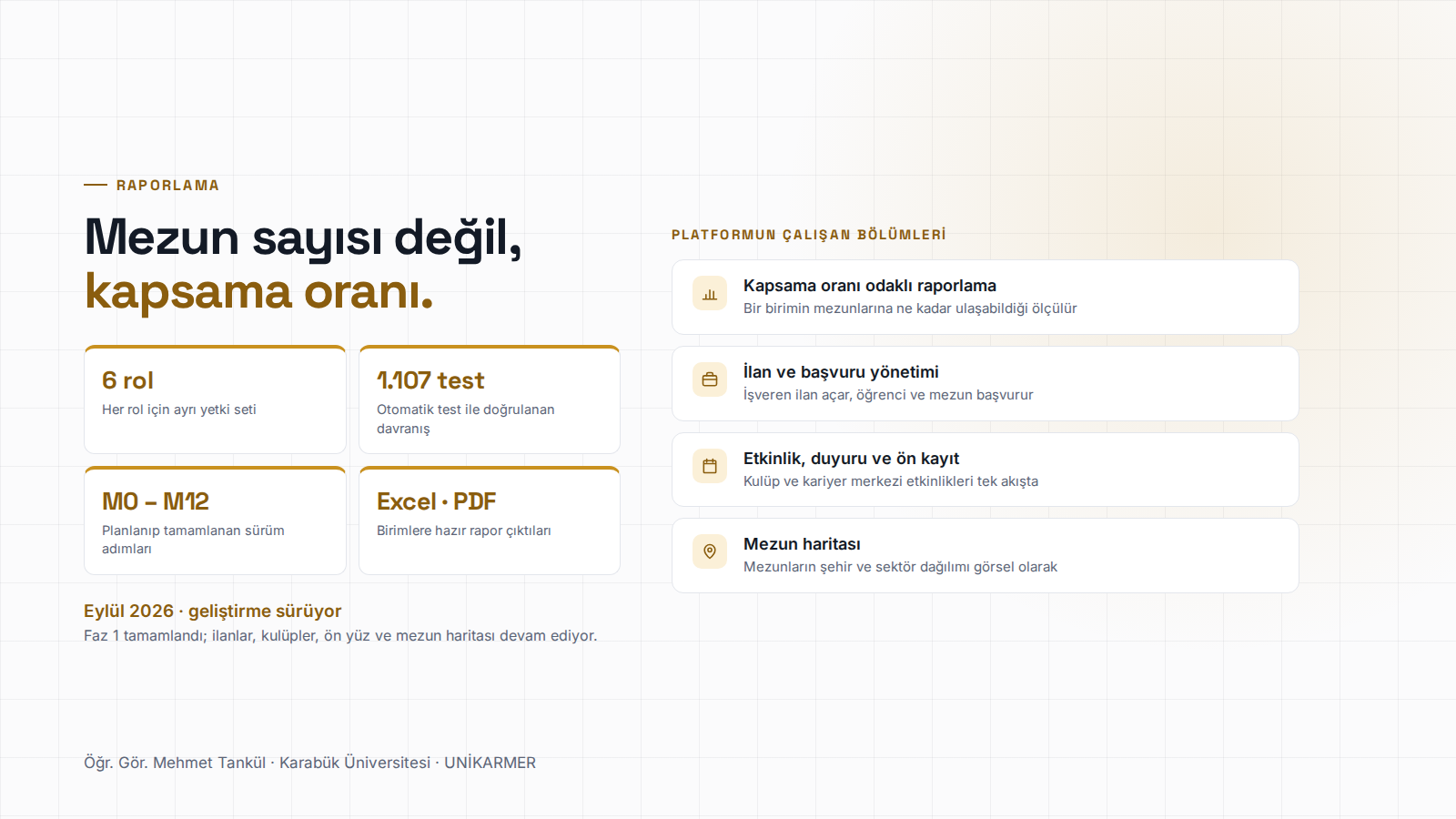
I made a deliberate choice on the reporting side. Reports are built around coverage rather than around the number of graduates: what is measured is not how many graduates a department has, but how many of them it can genuinely reach. That is both a meaningful indicator during accreditation and a realistic mirror for departments. Outputs are provided to departments as Excel and PDF files, filtered by date range and programme. The platform also includes job postings and application management, club pages, an events and announcements feed with event pre-registration, an alumni map showing the distribution of graduates by city and sector, and a separate dashboard for each user type. Phase 1 is complete; with the postings, clubs, front end, alumni map and event modules, the project has reached its twelfth release step, and the system's behaviour is verified by more than a thousand automated tests.
From the project