MANTSoft TÖSS Module

(TÖSS: Complementary and Private Health Insurance)
A module that took the registration, pre-authorisation, approval and invoicing of privately insured patients out of the hands of a single department and extended it to every reception desk in the hospital — producing contract-accurate invoices in seconds rather than weeks.
The problem it solved
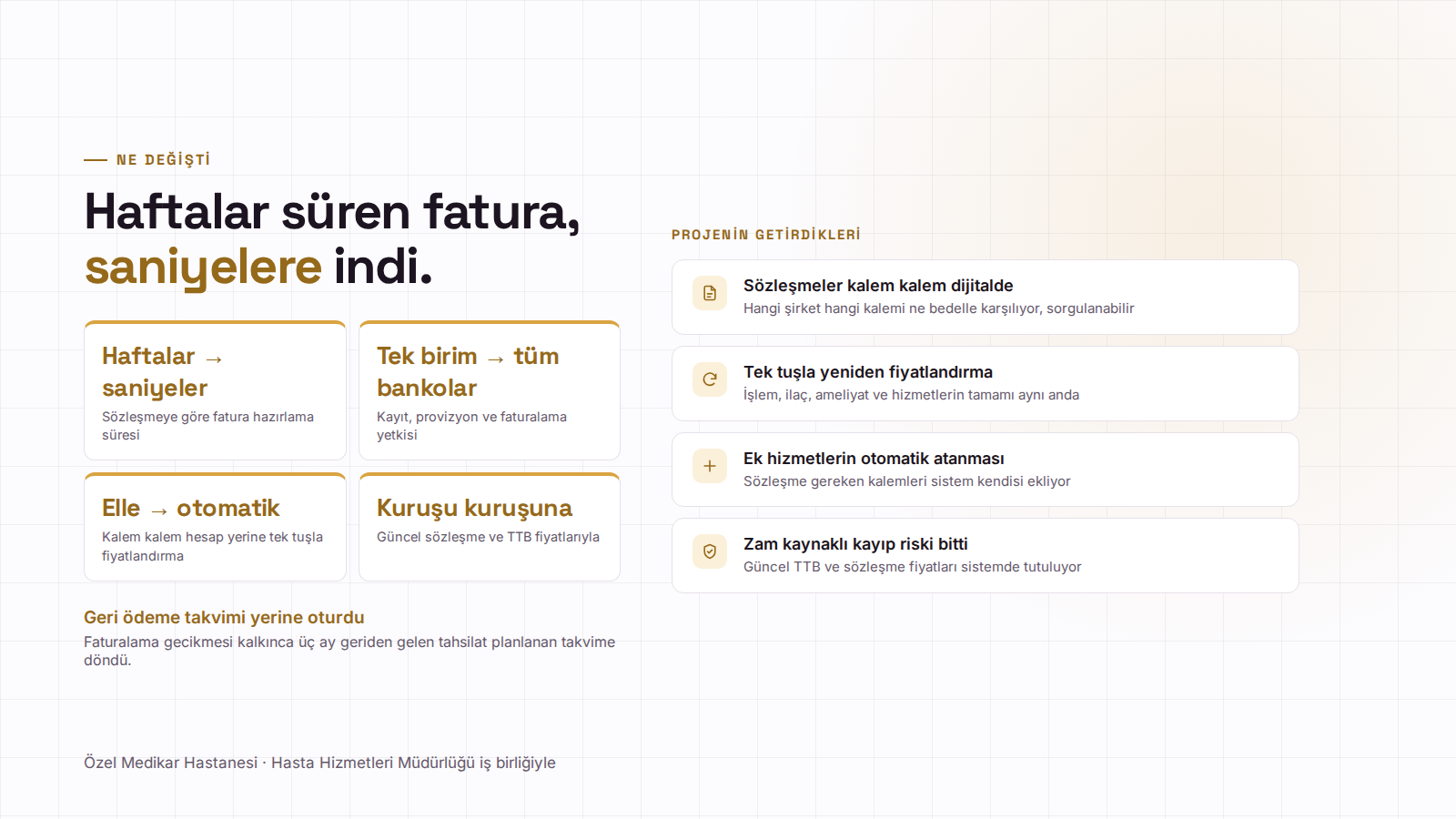
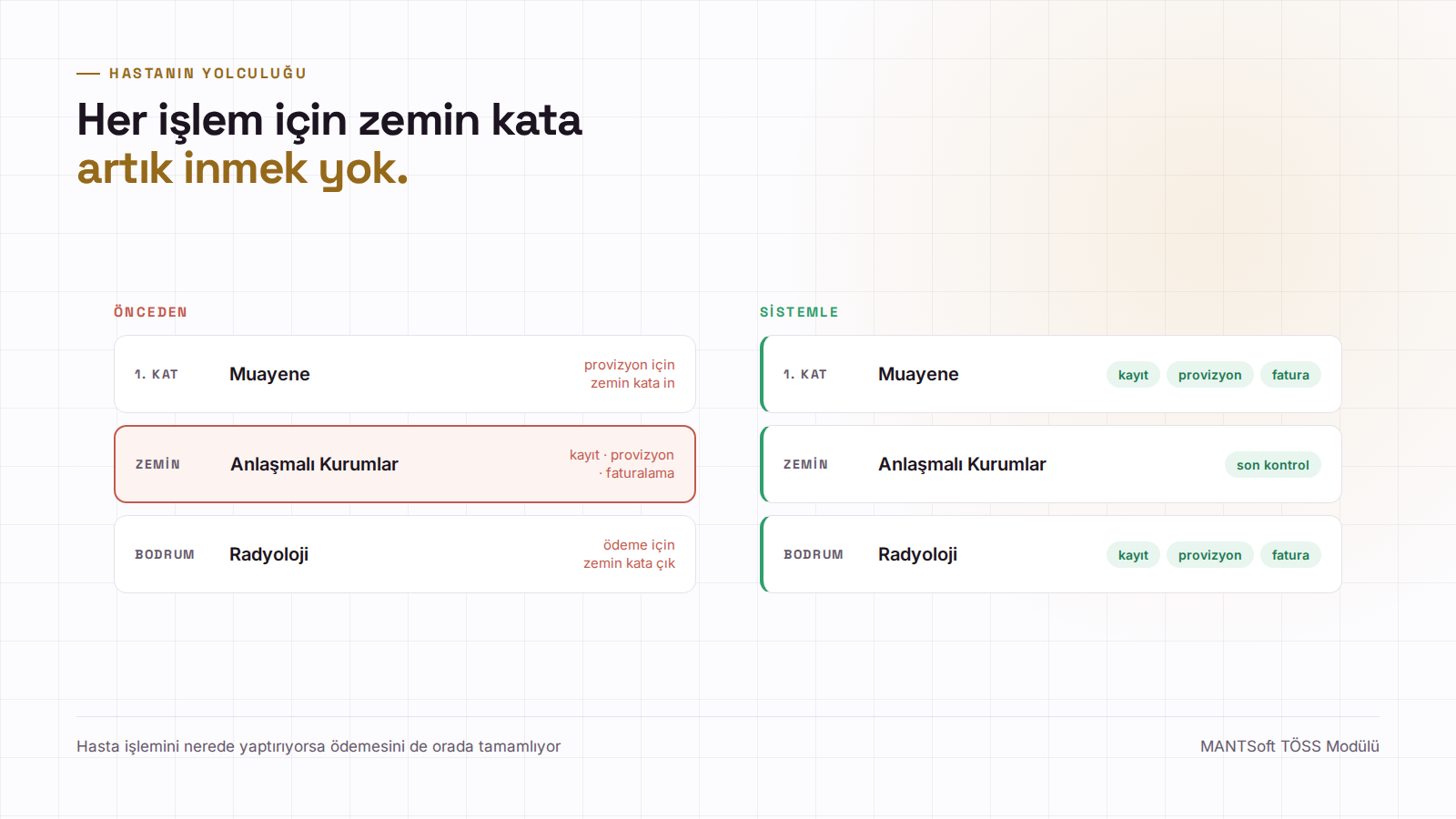
At the hospital, every step for patients with complementary or private health insurance — registration, pre-authorisation, approval and payment — was handled by the Contracted Institutions unit on the ground floor. Whether a patient went up to the first floor for a consultation or down to the basement for radiology, they had to return to the ground floor for each pre-authorisation and payment step, which regularly caused real dissatisfaction. Once treatment was complete, preparing the invoice in accordance with the contract signed with the relevant insurance company took weeks and sometimes months. Because the Meddata hospital information system could not apply contract prices to the patient record, every line item on the card was calculated by hand by the unit's staff, checking the contract item by item. Invoicing the records of long-stay inpatients in particular could take months, and no one outside that unit was able to do the work. Since reimbursements already arrived three months behind invoicing, every delay in invoicing pushed the institution's collections much further out. On top of this, when Turkish Medical Association tariffs were increased at the turn of the year and insurers did not reflect those increases in their pre-authorisation systems in time, staff who were not fully familiar with the contracts could unknowingly invoice at the old rates, causing financial loss.
How it works
The first step of the solution was not software but data. With the support of Patient Services Manager Ferhat Buday, every private and complementary health insurance agreement the hospital had signed was digitised item by item and loaded into the system; which company covers which item at what rate now lives in a queryable dataset rather than in a folder. That foundation had already been strengthened by the Hospital Service Tree Revision Project I had previously managed — without correct service definitions and codes, matching items to contracts would not have been possible in the first place. On the software side, the screen staff see was deliberately kept minimal: the user types the patient's protocol number, presses "Show", and the patient's details together with the institution they are covered by appear on screen. Once the right person is confirmed, pressing "Update" is enough; within seconds the software re-prices every procedure, medication, operation and service on the patient's record according to the contract, and automatically adds any supplementary services the contract requires.
What changed
The most visible change was in how far the patient has to walk. Insured patients can now complete registration and pre-authorisation at any reception desk in the hospital, and those same desks can complete the invoicing as well; no one depends on a single unit any more. Together with the training Ferhat Buday delivered to his team, the Contracted Institutions unit stopped being a registration desk, a pre-authorisation desk or an invoicing desk and became a final-check unit only. Invoices are now produced in seconds and to the last kuruş instead of taking weeks, and the records of long-stay inpatients are no longer left waiting for months. With the invoicing delay removed, reimbursements arriving three months behind now fall into the schedule the institution actually plans for. Because contract information is held in the system, tariff increases can no longer be missed and the financial losses caused by invoicing at outdated rates have ended. For patients, the outcome comes down to something very simple: wherever they receive the service, that is where they complete the payment.
Features
- Item-by-item digitisation of all private and complementary insurance agreements
- Single-screen patient and insurer lookup by protocol number
- One-click automatic re-pricing according to the contract
- Automatic addition of contract-required supplementary services to the record
- Registration, pre-authorisation and invoicing available at every reception desk
- Contracted Institutions unit repositioned as a final-check function
- Current tariff and contract prices applied, removing the risk of financial loss
From the project